
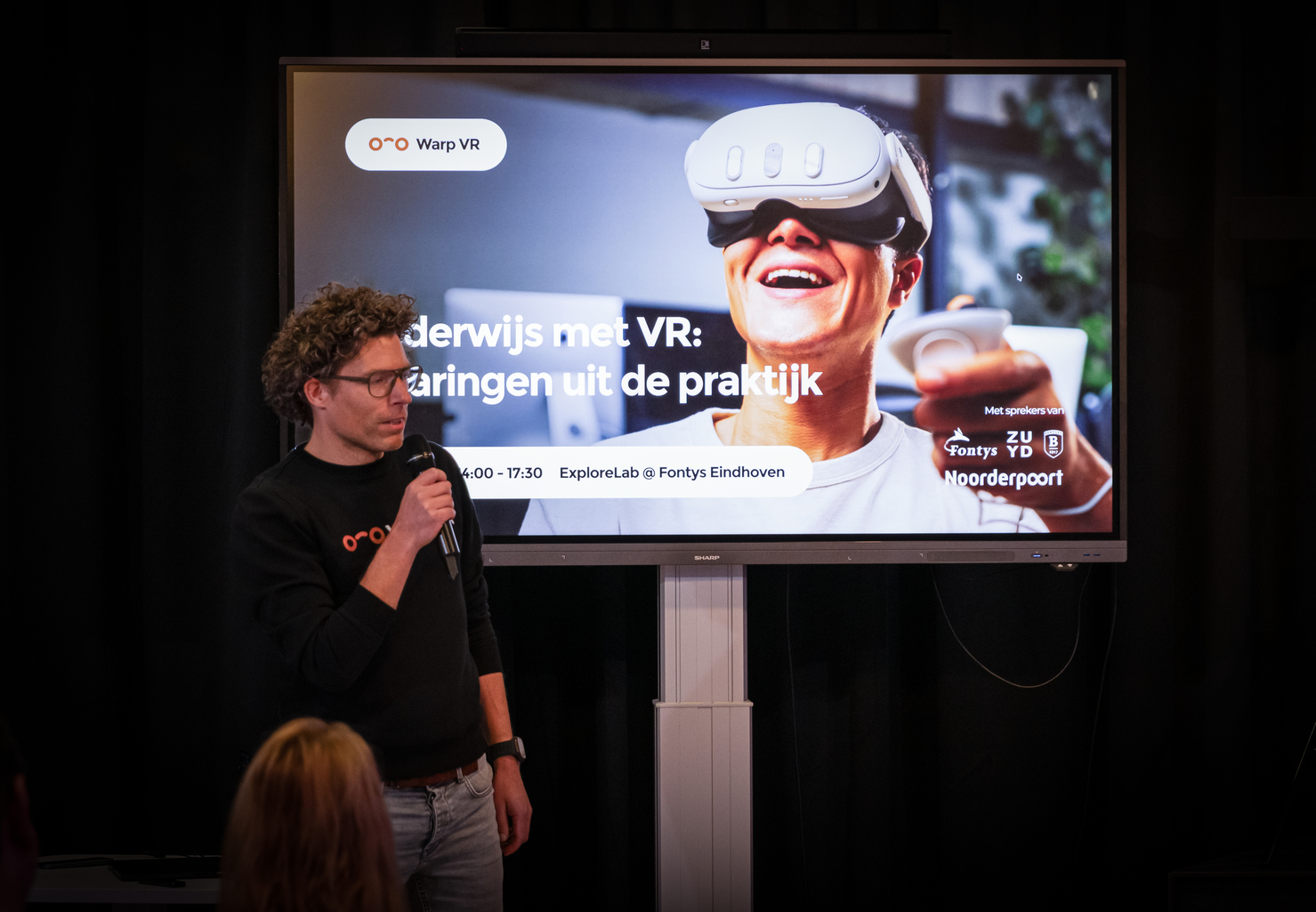
On April 15th, we hosted our first-ever VR in Education event at Fontys in Eindhoven and the energy in that room was something special.
More than 16 institutions showed up: Gilde Opleidingen, Noorderpoort, Zuyd Hogeschool, Nova College, Avans, Tilburg University, Koning Willem I College, Yuverta, Albeda, ROC van Amsterdam, Fontys, Talland College, Bentley University, Maastricht University, ACTA, and Saxion. Educators, researchers, and learning designers — all in the same room, trading stories about what works, what doesn't, and what's next.
The afternoon was packed with real use cases, honest results, and more than a few moments where you could feel the room lean in. Here's what happened.
%5B1%5D.jpg)
Patrick de Vos and Pieter van Gorkum from Fontys opened the content sessions with something we think is one of the most underrated ideas in educational VR: letting students build the scenarios themselves.
At Fontys, nursing and allied health students don't just use VR — they make it. They develop scenarios covering clinical reasoning, evidence-based practice, professional collaboration, and project management. The result is a learning experience that works on two levels: the students who will eventually use the scenarios learn from playing them, and the students who create them develop a much deeper understanding of the subject matter in the process.
It's also a smart answer to one of the most common barriers to VR adoption: who's going to make all this content? When students are the ones building it, the institution gets richer, more authentic scenarios — and the creators get a hands-on learning experience that no classroom exercise can replicate.
Rachel Kok, Educational Technology Advisor and researcher at Noorderpoort, showed how VR is being used to teach dental assistant students a precise cleaning protocol — something that's notoriously difficult to learn from a textbook or a one-time demo.
Before VR, the challenges were familiar: hard to visualize, passive students, limited practice time, and a real gap between theory and what the procedure actually looks and feels like. With 360° video in Warp VR on Meta Quest 3 headsets, students could now walk through the protocol step by step, make choices, and repeat the experience as many times as they needed.
The results spoke for themselves. Students reported a clear sense of added value, a much better understanding of the full protocol, and — crucially — they felt confident enough to perform it independently after the VR training. Beyond individual learning, Rachel noticed something unexpected: the VR experience sparked active, substantive discussion between students and colleagues about the protocol itself. Learning became more visual and practical, and complex procedures finally started to stick.
One of the highlights of the afternoon was Steve Salina from Bentley University's Academic Technology Center, who flew in from Boston to share peer-reviewed research on VR's effectiveness in student learning.
Together with Dr. Betsy Stoner (Assistant Professor of Environmental Science), Steve built an immersive 360° experience of Bahamas coastal marine ecosystems — mangroves, seagrass meadows, and hard-bottom environments — using Warp VR. The experience spans 22 videos and roughly 26 minutes of narrated, interactive content. It was designed to give students who can't access expensive field courses the same quality of learning.
They then ran a rigorous study: 86 students were split into three groups — Lecture + Field Visit to the Bahamas, Lecture + VR, and Lecture + 2D Video — and measured on learning gains before and after.
The finding? VR learning gains were significantly higher than those from the actual field experience (p = 0.01, published in Future in Educational Research, Stoner et al., 2025). One detail that stood out: only the VR group identified sea turtles as an important member of seagrass communities — because the VR scenario showed it explicitly in a way the field visit simply couldn't guarantee.
Students described the experience in their own words: "It allowed me to experience the beauty and diversity of ecosystems in an up-close and practical way that I've never been able to before." The VR scenarios are now also being used in the Bahamian science curriculum and at a local non-profit on Abaco Island.
Mark Pluymaekers and Anna Krispin from Zuyd Hogeschool's research group on Professional Communication closed the speaker sessions with a look at VR for oral communication skills training.
.jpg)
The use case is one that resonates across almost every educational sector: how do you give students enough practice for the difficult conversations they'll face in professional life? Giving feedback, de-escalating tense situations, delivering bad news, showing empathy under pressure. These skills can be explained in a classroom, but they can only really be developed through repeated practice in realistic situations.
VR, according to Mark and Anna's research, delivers on all four dimensions that matter most: more practice opportunities, higher realism, greater psychological safety, and stronger motivation. Their work also resulted in the development of an Extended CAMIL model specifically designed for VR-based oral communication training — a framework for educators who want to implement this properly, not just bolt VR onto an existing curriculum.
%5B1%5D.jpg)
Warp VR Library. We launched our free scenario library for education institutions — available immediately inside the platform. It opens with 15 ready-to-use VR scenarios, several of them contributed by Fontys. Log in, browse the library tab, and add any scenario to your workspace in one click. The library is education-exclusive and will grow over time. If you've built something worth sharing, we'd love to include it.
AI Scenario Builder. Our AI Scenario Builder is live in beta. Enter a learning goal, a situation, a character — and get a complete, structured VR scenario in under a minute. It's not a replacement for your expertise; it's a way to get from a blank screen to a working draft in the time it takes to make a coffee.
SurfConext SSO. Students and teachers can now log in with their institutional accounts. No extra passwords, no separate registration.
LTI 1.3 support. Warp VR now integrates directly with Canvas, Brightspace, Moodle, and other LMS platforms using the LTI 1.3 standard.
Immersive room support. We now support immersive rooms from Secta Medical — great for group sessions without individual headsets.
Remote View (coming soon). A standalone app that lets educators see what every student sees in their headset, in real time, and start or stop scenarios remotely from one screen. We're looking for institutions to help us test it — if you're interested, come talk to us.
What made this event different from a conference or a webinar was the quality of the conversations. Educators who have already been through the hard parts — figuring out the camera setup, building the first scenario from scratch, convincing a skeptical colleague — sharing that knowledge with people who are just starting out. Real results, real questions, real answers.
We're genuinely grateful to every institution that showed up, to every speaker who shared their work, and to the Fontys team for making the whole thing possible. This was the first edition. Based on how the afternoon went, it won't be the last — we're already planning to do it again next year.
If you couldn't make it this time, keep an eye on our channels. And if you're interested in the Warp VR Library, the AI Scenario Builder, or anything else mentioned in this post, we'd love to hear from you.
.jpg)


.png)