
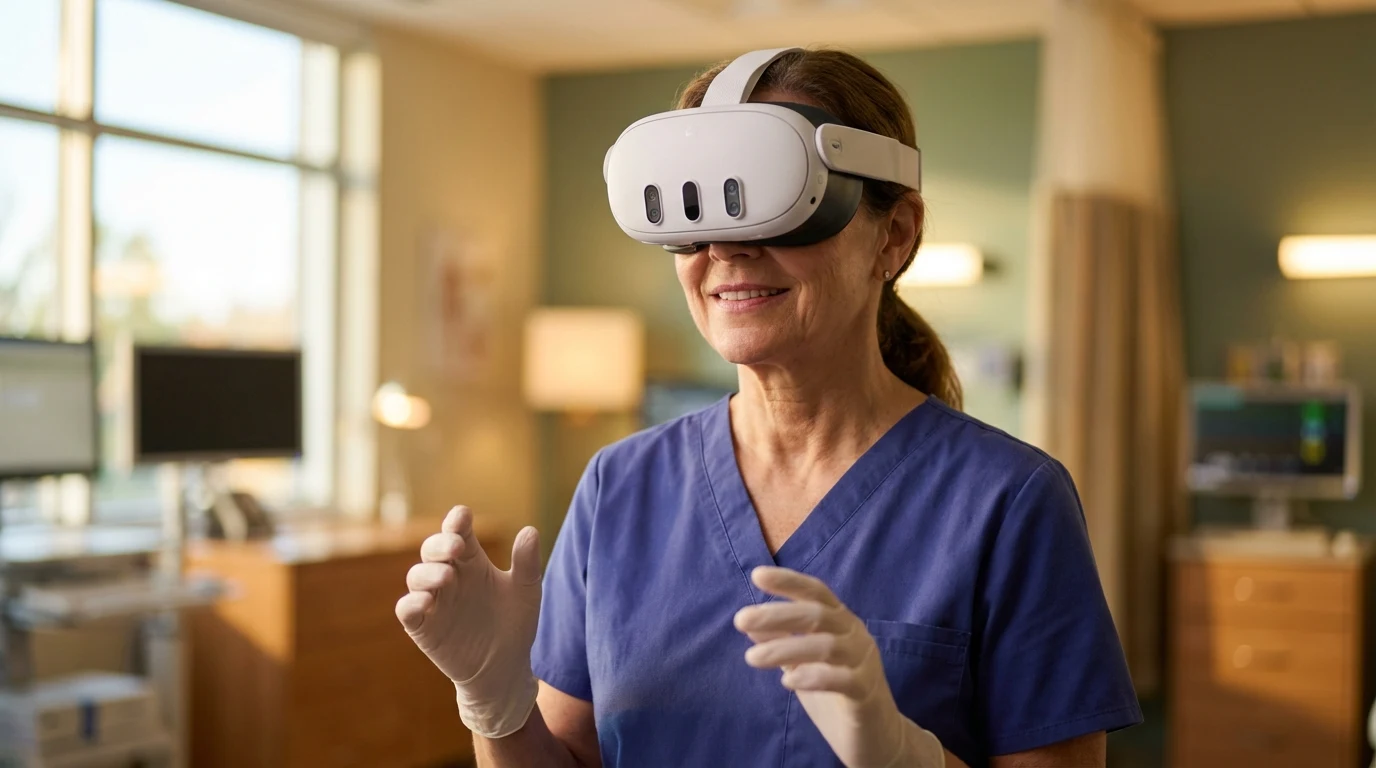
Let's take a look at the hard facts about healthcare training and VR.
VR training and Healthcare go hand in hand. The healthcare industry is one of the main adopters of VR, seeing wide usage across the world. This blog entry will explore why that is, and what kind of measurable impact it is having on the world of healthcare education.
Healthcare learners remembered what they learned better with VR.
Research shows a significant increase in knowledge retention in a study of over 1000 learners.
“Knowledge retention” refers to how much learners remember and understand after training. It’s one of, if not the primary indicator for whether a VR training (or any training) is effective. It is, of course, very hard to track, yet we can turn to a variety of studies that can provide a benchmark for training effectiveness.
The researchers found a significant improvement in knowledge retention compared to traditional methods. The study linked above is a review of many other researchers' work, all in all, comprising of 1167 individuals using VR for training and measuring their reactions and experiences.
VR learners scored nearly a full standard deviation higher than traditional learners (SMD 0.97). In practical terms, this means they remembered a lot more of what they learned. This is quite a large effect, showing a substantial improvement over other types of training.
VR doesn’t just help learners remember— it helps them perform more reliably and consistently, which is valuable in healthcare settings where good decisions and confident actions matter.
Knowledge retention isn't much use unless learners are able to act on what they've learned, not simply remember it.
The 2023 BMC Medical Education meta-analysis found that VR training leads to a meaningful improvement in practical skills. In everyday terms, this means healthcare learners who train in VR perform noticeably better on real-world clinical tasks compared to those who train with traditional methods alone. These tasks include things like assessing a patient, making informed decisions, communicating clearly, prioritizing steps, and navigating dynamic clinical environments.
In practical terms, a VR-trained learner has roughly a 64% chance of outperforming a traditionally trained peer on the same task.
VR helps learners feel more prepared, more capable, and more ready to act. That emotional readiness is crucial in patient-facing roles.
Another meta-analysis from 2024 found that VR training increases confidence and self-efficacy with an SMD of 0.60, which falls into the moderate-to-large range, meaning the effect is both statistically strong and noticeable.
This is a very lengthy study that examines different healthcare tasks and disciplines individually. It comprises of over 2000 independent studies, with some of the main topics covered being internal medicine, emergency medicine, surgical and procedural training, anatomy education, and communication and patient-interaction skills.
Here’s how that translates: A VR-trained learner feels significantly more confident than a traditionally trained peer. Why is confidence so important? Because in healthcare, confidence directly affects communication, decision-making, and performance under pressure.
"Empathy has been shown to improve patient care while reducing healthcare provider burnout, and our findings suggest that VR that sustains neurologic Immersion should have a larger place in clinician education." - 2025 Study.
While technical skills are vital, the ability to understand a patient’s experience, empathy, is equally crucial for high-quality care, patient satisfaction, and trust.
A recent 2025 study demonstrated that immersive VR can be significantly more effective than traditional methods (like 2D films or lectures) in fostering empathy. The research found that VR generated 60% more neurologic immersion in nursing students than 2D films alone, significantly increasing their empathic concern.
By using 360° video, healthcare professionals can vicariously experience the sensory challenges, anxieties, and environmental triggers that patients face such as living with dementia, navigating acute chronic pain, or receiving a difficult diagnosis. This immersive perspective-taking transforms empathy from an abstract concept into an actionable clinical skill, improving communication and compassionate care.
Across multiple large-scale studies, VR training shows consistent, measurable benefits for healthcare education. Learners retain more information, perform better in practical tasks, feel more confident in clinical situations, and develop stronger empathy for patients.
What makes VR particularly valuable in healthcare is that it connects learning to action. Knowledge retention improves, but so does the ability to apply that knowledge under pressure. Skills transfer more reliably to clinical practice, and increased confidence supports clearer communication and better decision-making. On top of that, immersive experiences allow clinicians to better understand the patient perspective, which directly impacts quality of care and provider well-being.


.jpg)
