The Faculty of Security Engineering at the University of Žilina educates future professionals in crisis management and safety-related fields, whose role is to identify hazards, understand their sources, assess risks, and contribute to the implementation of appropriate safety measures within complex systems and industrial processes.
As part of the Erasmus+ SAFAR project, the University of Žilina collaborated with industrial partners, including Kia Slovakia and a Czech manufacturing company, to develop immersive VR training scenarios based on real workplace procedures and operational tasks carried out in industrial environments characterized by different hazards, processes, and safety requirements.
While the scenarios were built around authentic tasks performed by production operators, their purpose within higher education was not to train students for these specific operational roles. Instead, they were designed to enhance students’ situational awareness, improve their understanding of industrial processes, support hazard identification, and provide insight into the risks and safety measures associated with different workplaces. By completing the activities embedded within the scenarios, students were exposed to realistic industrial environments and gained a deeper understanding of the relationship between work processes, hazards, and risk management practices.
The development of these scenarios was carried out in parallel with the creation of the SAFAR framework and represented one of its practical implementation components. Through the collaborative efforts of the Erasmus+ SAFAR consortium, the project combines practical XR-based learning experiences with a transferable framework intended to support the adoption of XR technologies in vocational and higher education institutions across Europe.
Universities increasingly want to use VR in their training programmes. The technology and appetite are both there. But desire alone isn’t enough to get a top notch immersive learning scenario off the ground.
While scenarios do get built, sometimes they don't connect to the curriculum in a meaningful way. Scoring may not align with existing educational standards, so the training can't officially count toward a qualification. Teachers don't have the background to run XR sessions confidently, so the headsets end up gathering dust. The hardware gets purchased without anyone mapping out the infrastructure needed to actually deploy it.
For Samuel Kočkár and his team at the University of Žilina, this was the core problem to solve. Their faculty focuses on security engineering and crisis management, which means they need to train students in high-stakes, high-risk environments: forklift operations, industrial safety procedures, and emergency response. They don't have a factory floor or an automotive plant on campus. Traditional training methods can't bridge that gap.
Even when they could simulate a scenario, they knew from experience that technology alone wasn't enough. A survey of trainers across the SAFAR consortium confirmed the scale of the problem: 80% cited ongoing technical support as their primary concern when adopting new digital training tools, and 75% described themselves as enthusiastic early adopters who still lacked the structure to move forward confidently.
Enthusiasm without a framework doesn't get VR into a curriculum. It just creates expensive experiments. What the University of Žilina needed was a platform non-technical staff could own and update independently, and a structure that made the whole thing sustainable long-term.
Zilinska University and partners participating in the SAFAR project use several different technologies when it comes to VR, including Unity 3D and Warp VR because not every tool fits every scenario. While Unity 3D is a strong choice for fully programmable 3D scenarios, not every scenario calls for that level of complexity. For many training situations, filming in 360 degrees is faster, cheaper, and just as effective which is often a much better fit for educational institutions.
Experience gained during the Erasmus+ project FightAR, which served as a predecessor to the SAFAR project, highlighted several practical limitations associated with the use of Microsoft HoloLens 2. The technology was employed for the visualization of holographic content and the execution of guided work procedures through Microsoft Dynamics 365 Remote Assist and Guides. However, testing in outdoor environments revealed challenges related to the visibility of holographic elements under high ambient light conditions.
Since HoloLens 2 relies on an optical see-through display, holograms are projected onto transparent lenses, resulting in reduced contrast and readability of virtual content under strong sunlight. Based on these experiences, the SAFAR project adopted Meta Quest 3 as its primary XR platform. Unlike HoloLens 2, Meta Quest 3 utilizes a video pass-through approach, where the real environment is captured by external cameras and digitally combined with virtual content, enabling more consistent visualization of virtual objects across varying lighting conditions.
Furthermore, the Warp VR platform proved to be a highly effective tool for the development of immersive training scenarios. In contrast to the FightAR approach, where scenario modifications often required technical support and were constrained by predefined step-by-step workflows within Remote Assist and Guides, Warp VR enables educators and domain experts to independently create, modify, and update training scenarios without programming expertise. This significantly increases flexibility, reduces development time, and allows training content to be adapted more efficiently to specific educational and operational requirements.
The SAFAR project, a European Union-funded Erasmus+ initiative exploring immersive technology in vocational education, took a three-part approach to making VR training work in practice.
First, the team built training scenarios in genuine industrial environments, co-developing content directly with the companies whose employees would use it. Working with KIA Slovakia, they created a forklift operator safety training scenario set inside an automotive manufacturing facility, built entirely in Warp VR by the university team itself. A second scenario, developed with a Czech industrial partner, covers heat shrink tubing procedures for electrical wiring, structured as a two-part experience: a linear walkthrough for learning, followed by a scored assessment with multiple choice questions.
The co-development model solved two problems at once. The university gained access to real industrial environments and accurate, up-to-date procedures that made the scenarios credible. The companies gained training content they could use for their own employees. Both parties got something they couldn't easily produce independently.
Perhaps the most interesting aspect of the entire project is the development of three guidebooks that can be used by other institutions to develop quality immersive learning scenarios as well as integrate them into curriculums that meet standards.
This is the hands-on manual for educators who want to use VR but don't know where to start pedagogically. It covers how to match the right technology to the right learning outcome: interactive scenarios for procedural skills where someone needs to carry out a sequence of actions, and 360 video for situations where the goal is to recognise cues or recall foundational knowledge. It includes a structured three-phase lesson plan template covering the technical briefing, the scenario itself, and the post-session debrief and assessment. It also has a section on practical challenges from real pilots that answers recurring questions like what to do when hardware becomes obsolete mid-project, how to manage trainer resistance, and how to keep content current when procedures change. It was built directly in response to the consortium survey where 80% of trainers said technical support was their biggest need. Any teacher, regardless of technical background, can pick this up and deliver a VR training session that is pedagogically sound and counts toward a qualification.
This covers everything an institution needs to actually deploy VR training at scale. Hardware selection and procurement, software setup, device management, WiFi and network requirements, data security, and how to integrate with existing Learning Management Systems. It also addresses the organisational side: how to build a business case internally, how to structure the rollout in phases, and how to plan financially for ongoing subscription costs and hardware replacement cycles. It is essentially the document that prevents institutions from buying headsets and then realising six months later that their WiFi can't support them, their IT team doesn't know how to manage the devices, and nobody budgeted for content updates.
Before you spend a single euro on hardware, read this. It maps every operational decision you will need to make before VR training can actually run inside your institution.
This is the framework that addresses the human side of VR adoption. It defines four core competence areas every institution needs to cover: technological literacy, pedagogical planning, scenario development, and quality assurance. Its most distinctive contribution is the concept of the Digital Transformation Coach, a formally defined internal role for the person who owns the VR programme. It is a detailed competence profile with specific skills, responsibilities and assessment criteria. It also connects directly to a six-module online certification course that trains and qualifies people for that role, covering everything from XR basics to scenario design, evaluation methodology and leading institutional change. The whole model was developed from surveys of trainers and decision-makers across the consortium, so it reflects real gaps rather than theoretical ones.
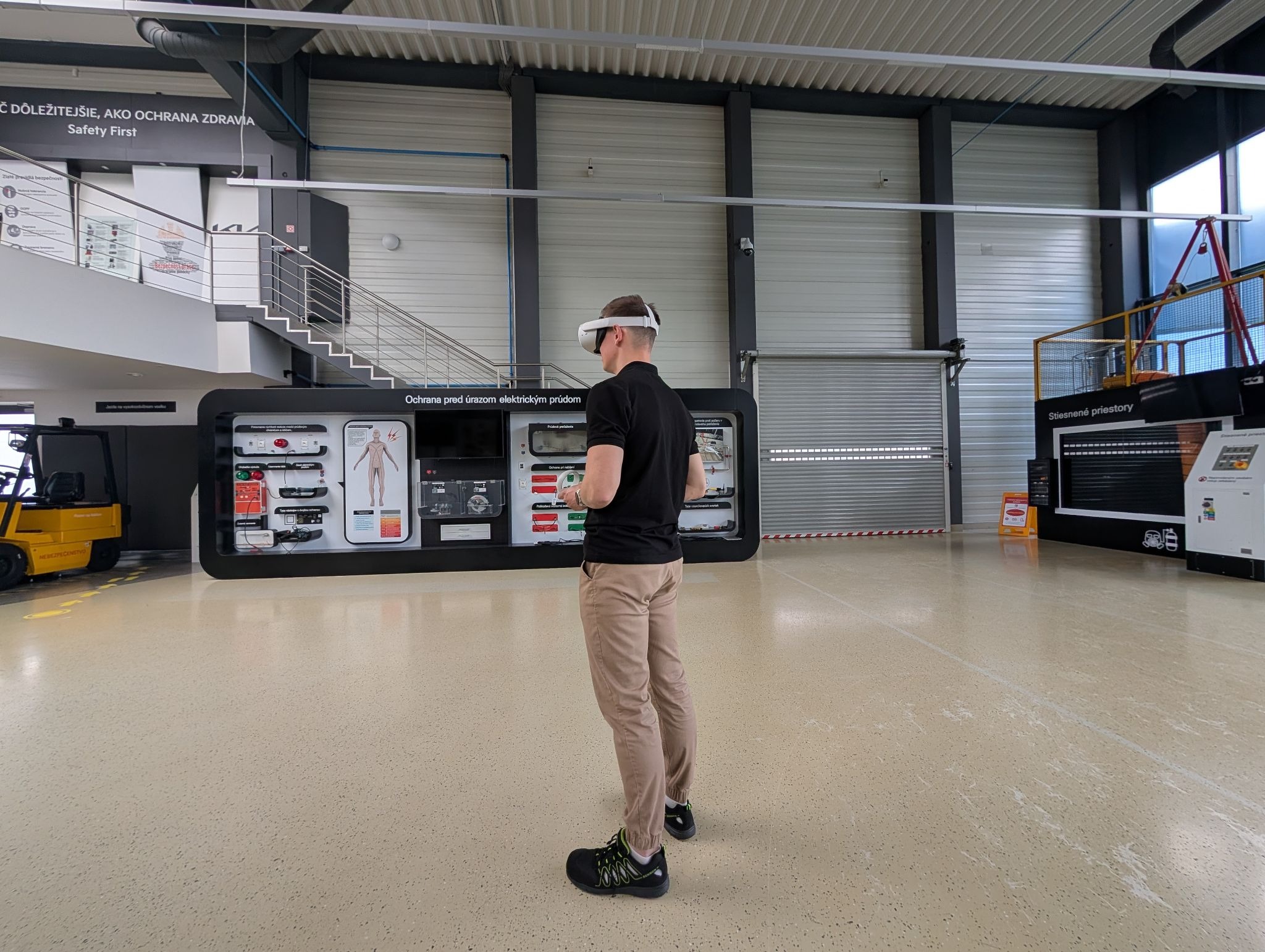
The KIA Slovakia forklift safety scenario is currently being tested with real forklift operators on-site at KIA's facility. The company is exploring how to incorporate it into their standard employee onboarding process. A scenario that began as a university research project is becoming a live industrial training tool.
Across the consortium, 87.5% of trainers said they want to use VR in both live and classroom settings, not just one or the other. The framework Žilina has developed is designed to support exactly that: immersive training that works as part of a blended learning approach, counts toward formal qualifications, and can be maintained by the institutions themselves without ongoing developer involvement.
"I don't have time to make my students into guinea pigs. Teachers need a framework they can trust from day one, not something they figure out by trial and error at the expense of the people they are supposed to be teaching."
Samuel Kočkár, Faculty of Security Engineering, University of Žilina
The SAFAR project concludes at the end of 2026, but the framework developed by the Erasmus+ SAFAR consortium, of which the University of Žilina is a partner, is designed to outlast the project itself.The three documents are being made available as open educational resources, meaning any institution across Europe and beyond can access and apply them. The Digital Transformation Coach certification programme gives institutions a clear path to building sustainable internal expertise, not just a one-time implementation.
What makes this case study particularly relevant for other universities and vocational training providers is its breadth.It is a tested, documented approach to solving the structural barriers that prevent VR from moving beyond the demo stage and into the curriculum.
If your institution is exploring VR training and wants to move beyond the pilot phase, the combination of Warp VR's no-code platform and the SAFAR framework gives you the tools to do it properly. Developed through the collaborative efforts of the Erasmus+ SAFAR consortium, the framework provides a comprehensive guide covering pedagogy, infrastructure, organizational readiness, and human factors, while Warp VR helps translate these principles into practical training solutions.